
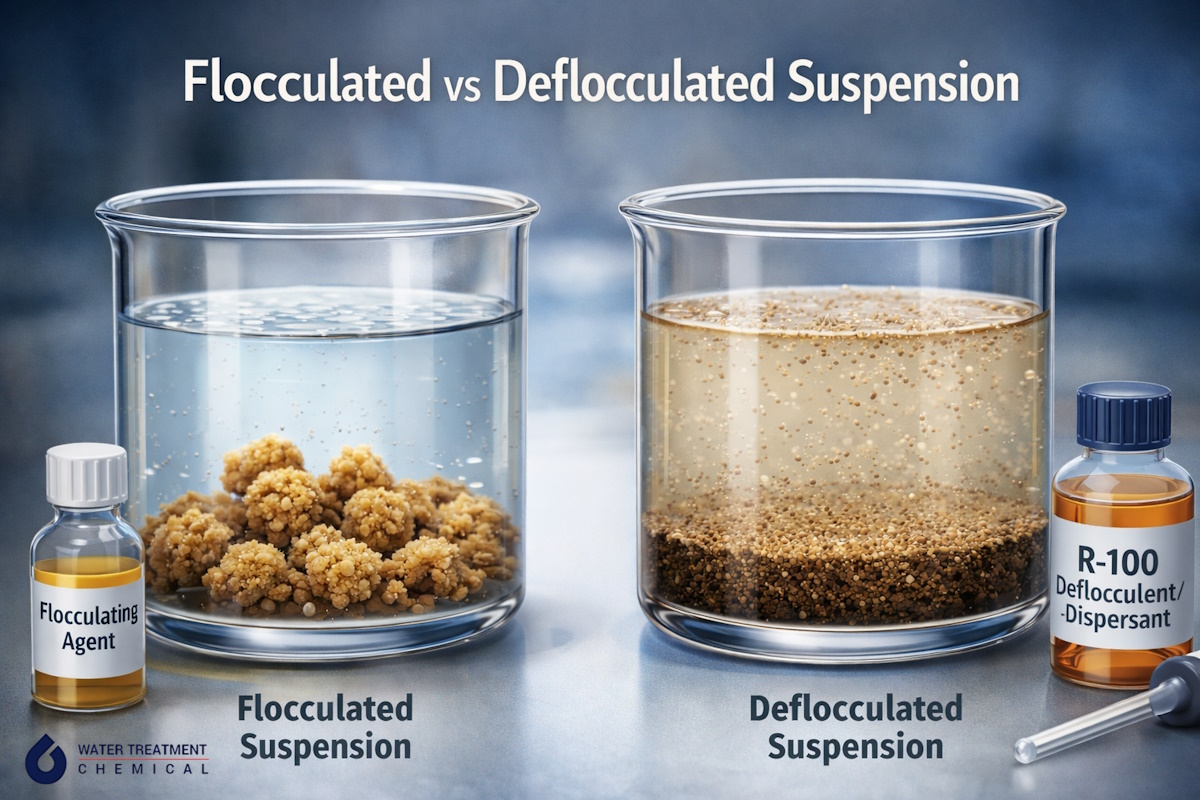
Suspensions are very common in pharmaceutical, food, cosmetic, and chemical products. Many liquid medicines, syrups, lotions, paints, and agricultural products are suspensions. A suspension is a system where solid particles are spread throughout a liquid medium. These solid particles do not dissolve in the liquid. Because of gravity, the particles slowly move downward and settle at the bottom. This settling behavior makes stability a very important factor in suspension formulation.
One of the main challenges in suspension systems is controlling particle settling and ensuring the product remains uniform during storage and use. Two major approaches are used to control this behavior in suspension systems. These approaches are known as Flocculated and Deflocculated Suspension systems. Each system has different stability characteristics, advantages, and limitations.
Understanding the stability differences between flocculated and deflocculated suspension systems is essential for formulators, students, and professionals working in suspension formulation. This article explains the concepts in simple words and compares both systems in detail. It also discusses the role of flocculating and deflocculating agents, including the use of R-100 Deflocculent-Dispersant, and how these agents affect stability.
Ready to improve the stability of your flocculated or deflocculated suspension?
What Is a Suspension?
A suspension is a two-phase system. One phase is solid, and the other is liquid. The solid particles are not dissolved but are dispersed in the liquid. Over time, gravity causes these particles to settle. The rate of settling depends on factors such as particle size, density, and the nature of the liquid.
An ideal suspension should have the following properties:
- Particles should settle slowly
- The settled particles should be easy to redisperse
- The suspension should remain uniform during dosing
- The product should look stable and appealing
To achieve these properties, formulators use either flocculated or deflocculated suspension systems.
Understanding Particle Interaction in Suspensions
To understand stability differences, it is important to understand how particles behave in a liquid. Solid particles in a suspension carry surface charges. These charges can be positive or negative. The interaction between these charged particles decides whether they attract or repel each other.
- When particles attract each other loosely, they form flocs
- When particles repel each other strongly, they remain separate
This behavior leads to the formation of flocculated or deflocculated suspension systems.
What Is a Flocculated Suspension?
A flocculated suspension is a system where particles form loose groups known as flocs. These flocs are formed due to weak attraction forces between particles. The attraction is controlled so that particles come together but do not stick tightly.
In a flocculated system, particles settle faster because flocs are larger and heavier. However, the sediment formed is loose and fluffy. This sediment is easy to redisperse with gentle shaking.
Key Features of Flocculated Suspension
- Particles form loose aggregates
- Faster settling rate
- Sediment is bulky and porous
- No hard cake formation
- Easy redispersion
What Is a Deflocculated Suspension?
A deflocculated suspension is a system where particles remain separate and do not form flocs. This happens due to strong repulsive forces between particles. Each particle behaves independently in the liquid.
In a deflocculated system, particles settle slowly because they are small and separate. However, over time, they pack closely at the bottom and form a hard cake. This cake is difficult to redisperse and affects product quality.
Key Features of Deflocculated Suspension
- Particles remain discrete
- Slow settling rate
- Compact sediment formation
- Risk of hard cake formation
- Difficult redispersion
Concept of Stability in Suspension Systems
Stability in suspensions does not mean that particles never settle. Instead, stability refers to how well the system maintains uniformity and how easily it can be restored to uniformity after settling.
A stable suspension should:
- Avoid hard cake formation
- Redisperse easily
- Maintain consistent dosing
- Remain visually acceptable
The stability behavior of flocculated and deflocculated suspension systems is very different.
Stability of Flocculated Suspension
Flocculated suspensions are often considered physically stable because they do not form hard cakes. Even though particles settle faster, the sediment remains loose.
Sedimentation Behavior
In a flocculated suspension, particles settle quickly as flocs. The supernatant liquid becomes clear faster. While this may look unstable, the sediment formed is easy to break up.
Redispersibility
Redispersibility is a major strength of flocculated systems. A few gentle shakes can restore uniformity. This ensures accurate dosing, especially in liquid medicines.
Volume of Sediment
Flocculated suspensions produce a larger sediment volume. This sediment occupies more space and has many pores filled with liquid. Because of this structure, particles do not pack tightly.
Long-Term Stability
Over time, flocculated suspensions maintain their redispersibility. There is minimal risk of irreversible settling. This makes them suitable for products with longer shelf life.
Stability of Deflocculated Suspension
Deflocculated suspensions show a slow settling rate initially. This may give the impression of better stability. However, this can be misleading.
Sedimentation Behavior
Particles in deflocculated suspension systems settle slowly and uniformly. The suspension may look stable for a longer time. But once particles settle, they pack closely together.
Cake Formation
One of the biggest problems with deflocculated suspension systems is cake formation. The particles form a dense and compact mass at the bottom. This cake is difficult or sometimes impossible to redisperse.
Redispersibility Issues
Hard cake formation leads to poor redispersibility. Vigorous shaking may not be enough to break the cake. This causes uneven dosing and product rejection.
Long-Term Stability
Deflocculated suspension systems are less stable in the long term. Once caking occurs, the product loses its usefulness. This is especially problematic in pharmaceutical suspensions.
Comparison of Flocculated and Deflocculated Suspension Stability
The stability differences between flocculated and deflocculated suspension systems can be clearly understood by comparing key parameters.
| Parameter | Flocculated Suspension | Deflocculated Suspension |
| Settling Rate | Settles faster | Settles slowly |
| Sediment Nature | Loose and fluffy | Dense and compact |
| Redispersibility | Easy | Difficult |
| Risk of Caking | Minimal | High |
| Visual Appearance | Clear supernatant | Cloudy longer |
Role of Flocculating and Deflocculating Agents
To control particle behavior, formulators use additives known as flocculating and deflocculating agents. These agents adjust the balance between attraction and repulsion forces.
Flocculating Agents
Flocculating agents reduce repulsive forces between particles. This allows particles to come together and form flocs.
Types of Flocculating Agents
- Electrolytes
- Polymers
- Surfactants
Mechanism of Action
Flocculating agents partially neutralize surface charges on particles. This reduces repulsion and allows weak attraction to dominate.
Effect on Stability
Flocculating agents improve redispersibility and prevent caking. They increase sediment volume and improve long-term stability.
Deflocculating Agents
Deflocculating agents increase repulsive forces between particles. This keeps particles separate and evenly dispersed.
Types of Deflocculating Agents
- Polyelectrolytes
- Dispersants
- Surface active agents
Mechanism of Action
Deflocculating agents increase surface charge on particles. This creates strong repulsion and prevents aggregation.
Effect on Stability
Deflocculating agents slow down settling but increase the risk of caking. Careful control is required to avoid instability.
Need help choosing flocculating or deflocculating agents?
R-100 Deflocculent-Dispersant
R-100 Deflocculent-Dispersant is a widely used deflocculating agent in suspension systems. It is designed to improve particle dispersion and reduce aggregation.
Role of R-100 Deflocculent-Dispersant
- Enhances particle separation
- Improves uniformity of dispersion
- Reduces particle agglomeration
- Controls viscosity
Effect on Deflocculated Suspension Stability
R-100 Deflocculent-Dispersant helps maintain a uniform distribution of particles in the liquid. It slows down settling and improves short-term stability. However, excessive use can increase the risk of cake formation.
Balanced Use in Formulation
The key to using R-100 Deflocculent-Dispersant is balance. It should be used in controlled amounts and often combined with other stabilizing agents to avoid hard sediment formation.
Importance of Controlled Flocculation
In many pharmaceutical suspensions, controlled flocculation is preferred. This approach combines the advantages of both systems.
What Is Controlled Flocculation
Controlled flocculation involves using flocculating agents to form weak flocs that prevent caking while maintaining acceptable settling rates.
Benefits of Controlled Flocculation
- Prevents hard cake formation
- Ensures easy redispersion
- Improves dose uniformity
- Enhances patient compliance
Practical Applications in Pharmaceuticals
Flocculated and deflocculated suspensions are used based on the nature of the drug and formulation goals.
Flocculated Suspensions in Medicines
- Antacid suspensions
- Antibiotic suspensions
- Pediatric syrups
These products require easy redispersion and accurate dosing.
Deflocculated Suspensions in Medicines
- Injectable suspensions
- Certain topical formulations
These systems require uniform particle distribution during use.
Stability Testing of Suspension Systems
Stability testing helps evaluate the behavior of suspensions over time.
Parameters Evaluated
- Sedimentation volume
- Redispersibility
- Visual appearance
- Particle size distribution
Importance of Testing
Testing ensures that the selected flocculated or deflocculated system maintains stability throughout shelf life.
Factors Affecting Stability Differences
Several factors influence the stability differences between flocculated and deflocculated suspension systems.
Particle Size
Smaller particles settle slower but cake more easily.
Viscosity of Medium
Higher viscosity reduces settling rate.
Concentration of Agents
Incorrect concentration of flocculating and deflocculating agents can destabilize the system.
Storage Conditions
Temperature and agitation affect particle behavior.
Advantages and Disadvantages Summary
Advantages of Flocculated Suspension
- Easy redispersion
- No hard cake
- Better long-term stability
Disadvantages of Flocculated Suspension
- Faster settling
- Clear supernatant
Advantages of Deflocculated Suspension
- Slow settling
- Uniform appearance
Disadvantages of Deflocculated Suspension
- Hard cake formation
- Poor redispersibility
Conclusion
The stability differences between flocculated and deflocculated suspension systems play a critical role in suspension formulation. While deflocculated suspensions appear stable due to slow settling, they often suffer from serious long-term stability problems such as hard cake formation. On the other hand, flocculated suspensions settle faster but offer superior redispersibility and long-term stability.
The choice between flocculated and deflocculated suspension depends on formulation requirements, type of product, and desired shelf life. The careful use of flocculating and deflocculating agents helps control particle behavior. Agents like R-100 Deflocculent-Dispersant are valuable tools when used correctly and in balanced amounts.
In most pharmaceutical applications, controlled flocculation provides the best balance between physical stability, ease of use, and patient safety. Understanding these systems helps formulators design better, safer, and more effective suspension products.
Still have questions about suspension stability or dispersing agents?