
Water treatment is an important process that helps make water safe for industrial use, agriculture, and human consumption. In many treatment systems, particles that float in water must be controlled so that the water becomes clear and usable. One key concept in this process is deflocculation in water treatment. While many people know about flocculation, fewer people understand what deflocculation means and why it matters.
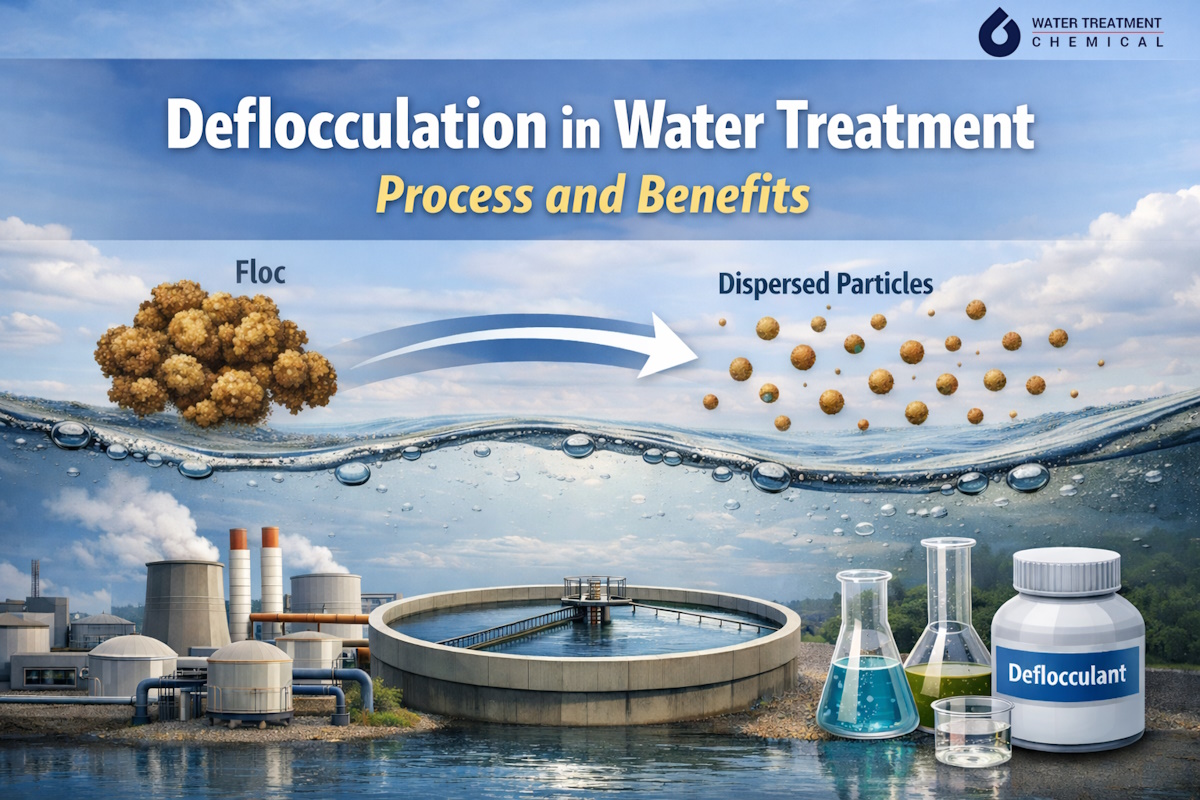
Deflocculation is a process that breaks apart clusters of particles in water so they remain evenly spread rather than sticking together. This helps improve water stability, prevent deposits, and support efficient filtration and chemical treatment.
In this article, we will explain what deflocculation means, why it is important in water treatment systems, how deflocculating agents work, and how products like R-100 Deflocculent-Dispersant are used in modern treatment processes.
Need help with deflocculation in water treatment?
Understanding Particle Behavior in Water
Water often contains many small particles such as clay, minerals, organic matter, and industrial residues. These particles may remain suspended or they may combine with each other to form larger clusters.
When particles join together, they form structures called flocs. This process is known as flocculation. Flocculation is commonly used in water treatment plants because larger flocs settle faster and can be removed easily.
However, there are many situations where the opposite effect is required. In certain systems, particle clusters cause problems such as blockages, scaling, or uneven chemical reactions. In these cases, the goal is to keep particles separated and evenly distributed.
This is where deflocculation in water treatment becomes important.
Deflocculation breaks apart particle clusters and prevents them from sticking together again. The particles remain dispersed in the water rather than forming large aggregates.
What Is Deflocculation in Water Treatment?
Deflocculation in water treatment refers to the process of dispersing suspended particles so that they remain separated instead of forming flocs.
This process is usually achieved by adding special chemicals called deflocculating agents. These chemicals change the electrical charge on particle surfaces, which prevents them from sticking together.
Most particles in water carry small electrical charges. When particles have opposite charges, they attract each other and form flocs. Deflocculating agents modify these charges so that particles repel each other instead of attracting.
As a result, the particles remain evenly distributed throughout the water.
This controlled dispersion is useful in several industrial and treatment applications where particle aggregation would create operational problems.
Why Deflocculation Is Important in Water Treatment
There are several reasons why deflocculation is used in water treatment systems.
1. Prevents Sediment Build Up
When particles cluster together, they settle quickly and form sediments. In pipes, tanks, and cooling systems, this sediment can reduce flow and lower system efficiency.
Deflocculation keeps particles dispersed so they remain suspended and can be removed through filtration or discharge.
2. Improves Filtration Performance
Evenly dispersed particles move more consistently through filters. Large flocs can clog filter media and reduce filtration performance.
By keeping particles separated, deflocculation helps maintain stable filtration and reduces maintenance requirements.
3. Reduces Scaling and Deposits
Many industrial water systems suffer from mineral scaling and deposits. These deposits often form when particles combine and settle on surfaces.
Deflocculating agents help prevent these clusters from forming, which reduces scaling inside pipes and equipment.
4. Enhances Chemical Efficiency
Some treatment chemicals work best when particles are evenly distributed. When particles clump together, the chemicals cannot interact with them properly.
Deflocculation improves the surface area available for reactions and allows treatment chemicals to work more effectively.
The Role of Deflocculating Agents
Deflocculating agents are chemicals that break apart particle clusters and keep them separated in water.
These chemicals are often polymers or dispersants designed to interact with particle surfaces. Once added to water, they attach to the particles and modify their surface properties.
The result is increased particle repulsion and better dispersion.
Common industries that use deflocculating agents include:
- Industrial water treatment
- Cooling tower systems
- Boiler water systems
- Mining and mineral processing
- Ceramic production
- Wastewater treatment
In all these applications, maintaining stable particle dispersion is essential for system performance.
How Deflocculating Agents Work
To understand How Deflocculating Agents Work, it helps to look at the basic science behind particle interactions.
Particles in water normally attract each other due to weak electrical forces. These forces allow particles to collide and stick together.
Deflocculating agents change this behavior in several ways.
1. Surface Charge Modification
Many deflocculants add negative charges to particle surfaces. When particles carry similar charges, they repel each other instead of attracting.
This electrostatic repulsion keeps particles separated and prevents floc formation.
2. Steric Stabilization
Some deflocculating agents form a protective layer around particles. This layer creates physical spacing between particles, which stops them from coming close enough to stick together.
This mechanism is known as steric stabilization.
3. Particle Dispersion
Deflocculants also help distribute particles evenly throughout the water. This dispersion prevents localized concentrations that might lead to sediment formation.
Because of these combined effects, deflocculating agents maintain stable suspensions in water treatment systems.
Need help choosing the right deflocculating agent?
Types of Deflocculating Agents
There are several types of deflocculating agents used in water treatment and industrial processes.
Polyphosphates
Polyphosphates are commonly used dispersants that prevent mineral deposits and keep particles suspended in water.
They are often used in boiler water treatment and cooling systems.
Sodium Silicates
Sodium silicates act as dispersing agents and help stabilize suspended particles.
They are commonly used in detergent and ceramic processing industries.
Organic Polymers
Polymeric deflocculants are widely used because they are effective at low concentrations. These polymers attach to particle surfaces and create strong repulsive forces.
Many modern treatment systems rely on polymer based dispersants.
Specialty Deflocculants
Some applications require specialized products designed for specific industrial conditions.
One example is R-100 Deflocculent-Dispersant, which is developed to maintain stable dispersion in challenging water systems.
R-100 Deflocculent-Dispersant in Water Treatment
R-100 Deflocculent-Dispersant is a specialized chemical product designed to control particle aggregation in industrial water systems.
It acts as both a deflocculant and a dispersant. This means it not only breaks apart existing particle clusters but also prevents new clusters from forming.
Key Functions
R-100 Deflocculent-Dispersant provides several important benefits:
- Prevents formation of particle flocs
- Keeps suspended solids evenly dispersed
- Reduces scaling and deposit formation
- Improves system cleanliness
- Enhances efficiency of filtration systems
Applications
This product is often used in:
- Cooling water systems
- Boiler feed water treatment
- Industrial process water
- Wastewater treatment plants
- Mining and mineral processing operations
Because it maintains particle stability, it helps protect equipment and maintain consistent water quality.
Deflocculation vs Flocculation
To fully understand deflocculation in water treatment, it is helpful to compare it with flocculation.
| Process | Purpose | Result |
| Flocculation | Combine particles into large flocs | Particles settle faster |
| Deflocculation | Separate particle clusters | Particles remain dispersed |
Flocculation is commonly used in drinking water treatment to remove impurities.
Deflocculation is more often used in industrial water systems where particle dispersion is needed to avoid deposits and blockages.
Both processes are useful but they serve different goals depending on the treatment requirements.
Industrial Applications of Deflocculation
Deflocculation plays an important role in many industries beyond standard water treatment.
Cooling Tower Systems
Cooling towers circulate large volumes of water. Suspended solids can accumulate and create deposits on heat exchange surfaces.
Deflocculating agents keep these solids dispersed so they can be removed through blowdown or filtration.
Boiler Water Treatment
Boiler systems require very clean water. Particle deposits inside boilers can reduce heat transfer efficiency.
Deflocculation helps maintain stable particle suspension and prevents scale formation.
Mining and Mineral Processing
Mining operations often process slurries that contain fine mineral particles.
Deflocculating agents help control the behavior of these particles and improve processing efficiency.
Ceramic and Clay Processing
In ceramic manufacturing, clay particles must remain evenly dispersed in water to create stable slurries.
Deflocculants reduce viscosity and improve flow characteristics of ceramic mixtures.
Benefits of Deflocculation in Water Treatment
The use of deflocculation offers many benefits for water treatment systems.
Improved System Efficiency
When particles remain dispersed, water flows more smoothly through pipes and equipment.
This improves overall system performance.
Lower Maintenance Requirements
Deposits and sediment buildup can cause frequent cleaning and maintenance.
Deflocculation reduces these issues and helps extend equipment life.
Better Chemical Performance
Even distribution of particles allows treatment chemicals to interact more effectively with contaminants.
This improves treatment results.
Reduced Operational Costs
By preventing deposits and improving efficiency, deflocculating agents help reduce operational costs in industrial systems.
Factors That Affect Deflocculation
Several factors influence how well deflocculation works in water treatment systems.
Water Chemistry
The pH level, mineral content, and ionic strength of water can affect how deflocculating agents interact with particles.
Particle Type
Different particles respond differently to dispersants depending on their size, shape, and surface charge.
Chemical Dosage
Using the correct dosage of deflocculating agents is essential. Too little may not provide effective dispersion, while too much can cause instability.
Mixing Conditions
Proper mixing ensures that the deflocculating agent spreads evenly throughout the water.
Without adequate mixing, the chemical may not interact with all suspended particles.
Challenges in Deflocculation
Although deflocculation is useful, it also presents certain challenges.
One challenge is maintaining the right balance between dispersion and treatment effectiveness. In some cases, overly dispersed particles may be difficult to remove from water.
Another challenge is selecting the right chemical formulation for specific water conditions.
This is why specialized products like R-100 Deflocculent-Dispersant are often used. These products are designed to work under specific industrial conditions and provide reliable performance.
Future Trends in Deflocculation Technology
Water treatment technology continues to evolve as industries look for more efficient and environmentally friendly solutions.
Some trends shaping the future of deflocculation include:
- Development of biodegradable dispersants
- Improved polymer technologies
- Smart chemical dosing systems
- Integrated treatment approaches combining filtration and dispersion control
These innovations will help improve the performance and sustainability of water treatment processes.
Conclusion
Deflocculation plays a critical role in modern water treatment systems. While flocculation focuses on combining particles for removal, deflocculation in water treatment focuses on keeping particles separated and evenly dispersed.
This process prevents sediment formation, reduces scaling, improves filtration performance, and supports efficient chemical treatment.
Deflocculating agents achieve this by modifying particle surface charges and creating repulsive forces that stop particles from clustering together.
Understanding How Deflocculating Agents Work helps engineers and operators design better treatment systems and maintain stable water quality.
Specialized products like R-100 Deflocculent-Dispersant offer advanced solutions for industrial water systems where particle control is essential.
As water treatment technologies continue to advance, deflocculation will remain an important tool for managing suspended solids and maintaining efficient, reliable water systems.
Need the right deflocculation solution?