
Water treatment and many industrial processes depend on controlling very small particles that float in liquids. These particles are often too tiny to settle on their own. Because of this, special chemicals are used to change how particles behave. Among these chemicals, deflocculating agents play a very important role.
Understanding How Deflocculating Agents Work at the particle level helps industries improve product quality, increase efficiency, and control suspensions in liquids. These chemicals are widely used in water treatment, ceramics, paints, drilling fluids, and many other industries.
In this article, we will explore How Deflocculating Agents Work, what they do at the microscopic level, and how they are different from flocculating agents. We will also look at why choosing the right water treatment chemical supplier is important for industrial operations.
Looking for reliable deflocculating agents for your industrial process?
Understanding Particle Behavior in Liquids
Before we understand How Deflocculating Agents Work, it is important to know how particles behave in water or other liquids.
When solid particles are mixed in water, they do not always stay separate. Many small particles have a natural attraction to each other. Because of this attraction, they often stick together and form clusters called flocs.
These clusters become heavier and may settle down in the liquid. In some processes this is helpful, but in others it is not desirable.
For example:
- In ceramic slurry preparation, particles must stay evenly dispersed.
- In paints and coatings, particles must not clump together.
- In drilling fluids, particles must remain suspended for proper flow.
When particles clump together, the mixture becomes unstable and difficult to use.
This is where deflocculating agents come into action.
What Are Deflocculating Agents?
Deflocculating agents are chemicals that help break apart particle clusters and keep particles evenly dispersed in a liquid.
These agents reduce the natural attraction between particles. As a result, particles stay separate instead of forming flocs.
In simple terms, deflocculating agents prevent particles from sticking together.
Some common examples of deflocculating agents include:
- Sodium hexametaphosphate
- Sodium silicate
- Polyphosphates
- Sodium carbonate in some systems
- Certain organic dispersants
These chemicals work at a microscopic level and affect the electrical and chemical forces around particles.
How Deflocculating Agents Work at Particle Level
To understand How Deflocculating Agents Work, we must look at the forces that act between particles.
Particles in water usually carry electrical charges on their surfaces. These charges create forces that either attract or repel other particles.
When attraction forces dominate, particles come together and form flocs.
Deflocculating agents change these forces.
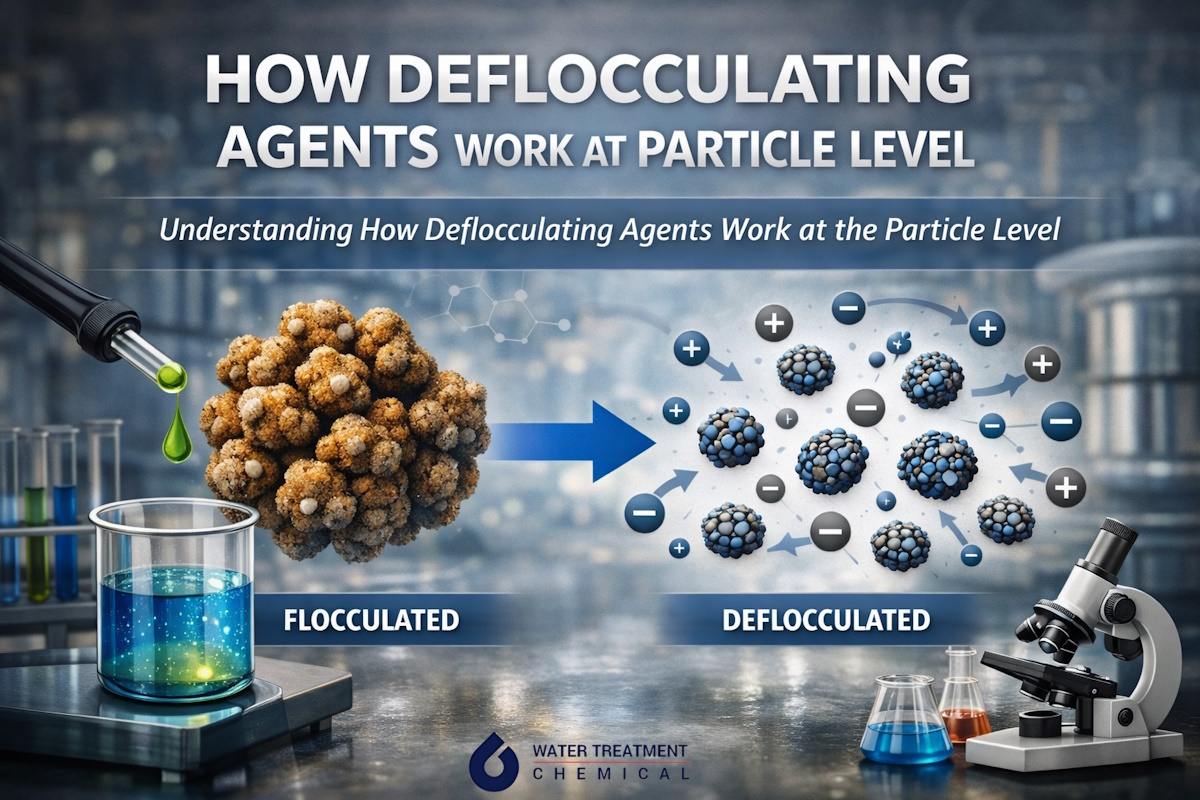
1. Increasing Surface Charge
One of the main ways deflocculating agents work is by increasing the electrical charge on particle surfaces.
When particles gain stronger negative charges, they repel each other.
Because like charges repel, particles push away from each other instead of sticking together.
This process helps break apart particle clusters and keeps them separated in the liquid.
2. Creating Electrostatic Repulsion
After the surface charge increases, particles experience electrostatic repulsion.
This repulsion acts like a protective force field around each particle.
When two particles come close, the repelling force pushes them apart.
This prevents the formation of flocs and keeps the suspension stable.
This mechanism is one of the most important parts of How Deflocculating Agents Work.
3. Dispersing Particle Clusters
In many suspensions, clusters of particles already exist before the chemical is added.
When a deflocculating agent is introduced, it slowly breaks these clusters apart.
The chemical moves toward the particle surface and attaches to it.
Once attached, it increases repulsion forces and pushes particles away from each other.
Over time the suspension becomes smooth and evenly dispersed.
4. Reducing Viscosity of Suspensions
Another important result of How Deflocculating Agents Work is viscosity reduction.
When particles stick together, they create a thick and heavy mixture.
But when particles remain separate, the liquid flows more easily.
This is why deflocculating agents are widely used in ceramic slurry preparation and drilling fluids.
A well deflocculated suspension can contain more solid particles while still remaining fluid.
Difference Between Flocculating and Deflocculating Agents
Many people confuse flocculating and deflocculating agents, but they serve opposite purposes.
| Feature | Flocculating Agents | Deflocculating Agents |
|---|---|---|
| Purpose | Help particles come together | Keep particles separated |
| How They Work | Cause small particles to join and form larger clusters | Break particle clusters and disperse them |
| Result | Larger clusters settle faster in liquids | Particles remain evenly dispersed in suspension |
| Main Function | Remove suspended particles from water | Maintain stable suspensions |
| Common Applications | Wastewater treatmentDrinking water purificationSludge separationIndustrial filtration | Ceramic processingPaint productionMineral processingOil drilling fluidsPaper coating |
The main difference between flocculating and deflocculating agents depends on their function. Flocculating agents make particles come together and settle, while deflocculating agents keep particles apart to maintain stable suspensions.
Need help choosing between flocculating and deflocculating agents?
Flocculated and Deflocculated Suspension
A flocculated and deflocculated suspension explains how particles behave in a liquid.
In a flocculated suspension, small particles join together and form loose clusters called flocs. These clusters become heavier and settle faster in the liquid. This is useful in water treatment because it helps remove suspended particles.
In a deflocculated suspension, particles stay separate and spread evenly in the liquid. The particles do not stick together, so the suspension stays stable. This type of suspension is useful in industries such as ceramics, paints, and drilling fluids where smooth flow and even particle distribution are important.
Electrical Double Layer and Particle Stability
Another important concept in understanding How Deflocculating Agents Work is the electrical double layer.
Every particle in water has an electrical charge on its surface. Around this surface, ions from the liquid gather and form two layers.
These two layers are called the electrical double layer.
When particles come close, these layers interact.
If the layers are strong enough, they push particles away from each other.
Deflocculating agents increase the strength of this double layer. This makes the repulsion stronger and keeps particles separated.
This phenomenon plays a key role in maintaining suspension stability.
Role of pH in Deflocculation
pH is another important factor that affects How Deflocculating Agents Work.
The pH level of water changes the surface charge of particles.
In some pH conditions, particles lose their electrical charge and begin to attract each other.
When this happens, flocculation occurs.
Deflocculating agents often adjust the pH of the solution or interact with particles in a way that restores surface charge.
Because of this, maintaining the correct pH level is important for effective deflocculation.
Industrial Applications of Deflocculating Agents
Deflocculating agents are widely used across different industries.
Understanding How Deflocculating Agents Work helps engineers control suspension stability and improve product performance.
Ceramic Industry
In ceramic production, clay particles must remain evenly dispersed in water to form smooth slurry.
Deflocculating agents reduce viscosity and prevent clay particles from clumping.
This allows manufacturers to use less water while maintaining good flow properties.
Paint and Coating Industry
Paint contains pigment particles suspended in liquid.
If these particles form clusters, the paint becomes uneven and difficult to apply.
Deflocculating agents keep pigment particles separated and evenly distributed.
This improves paint quality and shelf life.
Oil and Gas Drilling
Drilling fluids contain solid particles that help control pressure and remove rock cuttings.
Deflocculating agents maintain proper fluid flow and prevent solid particles from forming thick clusters.
This improves drilling efficiency and equipment performance.
Water Treatment Processes
Even though flocculants are more common in water purification, deflocculating agents are sometimes used in specialized water treatment systems.
They help control particle dispersion during certain chemical treatments.
A reliable water treatment chemical supplier often provides both flocculating and deflocculating agents depending on the treatment requirement.
Factors That Influence Deflocculation Efficiency
Several factors affect the performance of deflocculating agents.
Particle Size
Very fine particles are harder to control because they have stronger surface forces.
Deflocculating agents must be carefully selected for these systems.
Chemical Dosage
Using too little chemical may not fully disperse particles.
Using too much can cause instability or chemical imbalance.
Proper dosage is very important.
Mixing Conditions
Good mixing helps the chemical reach all particles.
Poor mixing can lead to uneven dispersion.
Water Chemistry
Minerals, salts, and other ions in water can affect particle charge and chemical performance.
Because of this, chemical selection should consider the water composition.
Choosing the Right Water Treatment Chemical Supplier
Selecting a reliable water treatment chemical supplier is very important for industries that use deflocculating agents.
A good supplier provides high quality chemicals that deliver consistent performance.
Here are some factors to consider when choosing a supplier:
Product Quality
High purity chemicals ensure better performance and predictable results.
Low quality chemicals may contain impurities that affect suspension stability.
Technical Support
A good supplier offers technical guidance on chemical dosage, application methods, and system optimization.
This support helps industries achieve better efficiency.
Industry Experience
Suppliers with strong industry experience understand the specific needs of different sectors.
They can recommend the best flocculating and deflocculating agents for each application.
Reliable Supply Chain
Consistent availability of chemicals is important for uninterrupted industrial operations.
A dependable supplier ensures timely delivery and stable supply.
Environmental Considerations
Modern industries also focus on environmental safety when using chemicals.
Some traditional chemicals may cause environmental concerns if not handled properly.
Because of this, many manufacturers are developing eco friendly deflocculating agents that are safer for water systems.
Working with a responsible water treatment chemical supplier helps industries choose chemicals that meet environmental regulations.
Future Developments in Deflocculating Technology
Research in particle chemistry continues to improve our understanding of How Deflocculating Agents Work.
Scientists are developing new types of dispersants that offer better performance and lower environmental impact.
Advanced polymer based dispersants are becoming more common.
These chemicals provide stronger particle stabilization and improved efficiency in complex industrial systems.
Nanotechnology and advanced surface chemistry are also opening new possibilities in suspension control.
These developments will make deflocculation more precise and efficient in the future.
Conclusion
Understanding How Deflocculating Agents Work at the particle level helps industries control suspension behavior and improve production processes.
Deflocculating agents break particle clusters, increase surface charge, and create repulsion forces that keep particles separated.
These chemicals play a key role in many industries such as ceramics, paints, drilling fluids, and specialized water treatment systems.
Knowing the difference between flocculating and deflocculating agents is important because each serves a different purpose. Flocculants help particles come together and settle, while deflocculants keep particles dispersed and stable.
For industries that rely on chemical treatment systems, working with a trusted water treatment chemical supplier ensures access to high quality products and expert support.
As technology continues to evolve, new and improved deflocculating agents will help industries achieve better efficiency, improved product quality, and more environmentally friendly processes.
By understanding particle level interactions and choosing the right chemicals, industries can maintain stable suspensions and achieve optimal performance in their operations.
Looking for high quality deflocculating agents?