
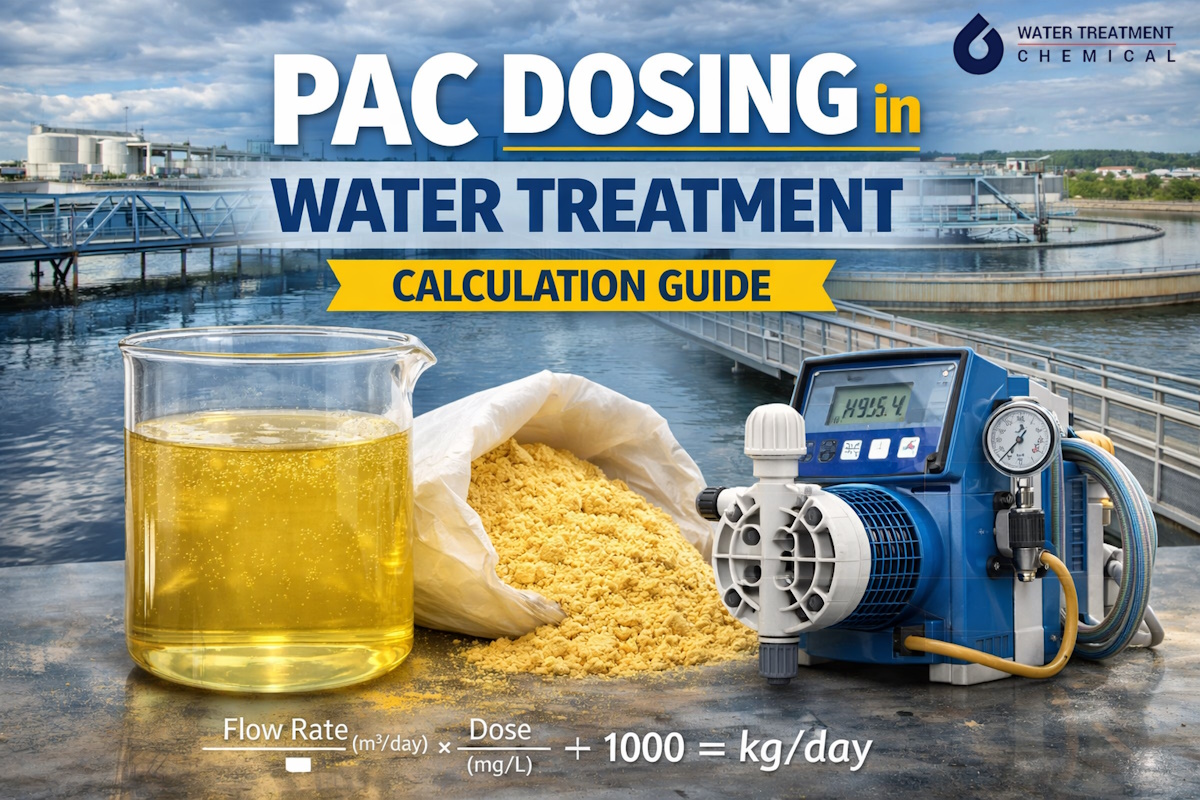
Water treatment is a critical process in many industries. Whether it is for drinking water, wastewater treatment, or industrial effluent management, proper chemical dosing plays a major role in achieving effective results. One of the most widely used chemicals in this process is Poly Aluminium Chloride, commonly known as PAC.
Understanding PAC dosing in water treatment is essential for plant operators, engineers, and decision-makers. Incorrect dosing can lead to poor clarification, increased sludge generation, higher costs, and even system inefficiencies.
In this detailed guide, we will explain how to calculate PAC dosing step by step, along with practical insights, factors affecting dosage, and best practices for achieving optimal performance.
What is PAC in Water Treatment?
Poly Aluminium Chloride (PAC) is a coagulant used to remove suspended solids, turbidity, color, and organic matter from water.
It works by neutralizing the negative charges of particles present in water. Once neutralized, these particles combine to form larger flocs that can be easily removed through sedimentation or filtration.
The use of PAC in water treatment has increased significantly due to its higher efficiency, lower sludge production, and better performance compared to traditional coagulants like alum.
Key Benefits of PAC Water Treatment
- Effective turbidity removal
- Works across a wide pH range
- Lower sludge production compared to alum
- Faster floc formation
- Reduced chemical consumption
PAC is commonly used in:
- Drinking water treatment plants
- Sewage wastewater treatment plants
- Industrial effluent treatment
- Textile and dye wastewater treatment
Need Help Choosing the Right PAC Grade?
Why is PAC Dosing Important?
Correct PAC dosing is crucial because:
- Under-dosing leads to incomplete coagulation
- Over-dosing can restabilize particles
- It impacts sludge volume and handling
- Affects downstream filtration performance
- Influences overall treatment cost
Proper dosing ensures:
- Clear water output
- Stable process performance
- Optimized chemical usage
Basic Principle of PAC Dosing Calculation
PAC dosing is generally calculated based on:
- Raw water quality
- Turbidity level
- Flow rate
- Jar test results
The standard unit for dosing is: mg/L (milligrams per liter)
Step-by-Step Method to Calculate PAC Dosing
Let us break down the calculation into simple steps.
Step 1: Conduct a Jar Test
A jar test is the most reliable way to determine the correct PAC dose.
What Happens in a Jar Test?
- Different PAC doses are added to multiple water samples
- Samples are mixed and allowed to settle
- The best dose is selected based on clarity and floc formation
Typical PAC Dosage Range
- Low turbidity water: 5–20 mg/L
- Medium turbidity: 20–50 mg/L
- High turbidity: 50–150 mg/L
Step 2: Identify Flow Rate
Flow rate is the volume of water being treated.
It is usually measured in:
- m³/hr (cubic meters per hour)
- L/hr (liters per hour)
Example:
If your plant processes 100 m³/hr, that equals:
100,000 liters per hour
Step 3: Use the PAC Dosing Formula
The standard formula for calculating PAC dosing is:
PAC Required (kg/hr) = (Dose in mg/L × Flow rate in m³/hr) ÷ 1000
Step 4: Example Calculation
Let’s assume:
- PAC dose = 30 mg/L
- Flow rate = 100 m³/hr
Calculation:
PAC Required = (30 × 100) ÷ 1000
PAC Required = 3 kg/hr
This means you need 3 kg of PAC per hour.
Step 5: Prepare PAC Solution
PAC is usually dosed as a solution.
Common Preparation:
- 5% to 10% solution
- Mix PAC powder or liquid with water
- Ensure proper stirring
If using a 10% solution:
To supply 3 kg PAC:
You need 30 liters of solution per hour
Factors Affecting PAC Dosing in Water Treatment
PAC dosing is not fixed. It varies based on several conditions.
1. Turbidity Level
Higher turbidity requires higher PAC dosage.
- Low turbidity → lower dose
- High turbidity → higher dose
2. pH of Water
PAC works best within a pH range of: 5.5 to 8.5
Outside this range, efficiency may reduce.
3. Temperature
- Cold water slows floc formation
- Higher temperatures improve coagulation
4. Organic Load
Water with high organic content needs higher PAC dosage.
5. Type of Contaminants
- Clay particles require different dosing
- Industrial dyes require higher doses
PAC Dosing in Different Applications
1. Drinking Water Treatment
- Low to medium dosing
- Focus on turbidity removal
- Strict quality standards
2. Wastewater Treatment
- Higher dosing required
- Removes suspended solids and COD
- Often combined with polymers
3. Textile Industry Effluent
- High color and chemical load
- PAC used with decolorizing agents
- Requires careful optimization
4. Industrial Effluent Treatment
- Varies based on industry
- Often requires trial-based dosing
Want to Optimize Your Chemical Consumption?
Common Mistakes in PAC Dosing
Avoiding these mistakes can improve performance:
1. Skipping Jar Tests
Assuming a fixed dose can lead to inefficiency.
2. Overdosing PAC
- Leads to excess sludge
- Increases cost
- May reduce clarity
3. Poor Mixing
Improper mixing reduces coagulation efficiency.
4. Ignoring pH Levels
pH imbalance reduces PAC performance.
5. Inconsistent Dosing
Fluctuating dosage leads to unstable results.
Best Practices for PAC Water Treatment
To achieve consistent results, follow these practices:
1. Always Perform Jar Testing
Regular testing ensures accurate dosing.
2. Maintain Proper Mixing Conditions
- Rapid mixing for dispersion
- Slow mixing for floc formation
3. Monitor Water Quality
Track:
- Turbidity
- pH
- TSS
4. Use Dosing Pumps
Automated dosing ensures consistency.
5. Combine with Polymers (if needed)
Polymers help improve floc size and settling.
How to Adjust PAC Dosing in Real-Time
Water quality changes frequently. So dosing should be flexible.
Indicators for Adjustment
- Increase in turbidity → Increase dose
- Poor settling → Adjust mixing or polymer
- High sludge → Reduce dose
Automation Advantage
Modern plants use sensors and dosing systems to:
- Adjust PAC dosing automatically
- Reduce manual errors
- Improve efficiency
Role of a Reliable Water Treatment Chemical Supplier
Choosing the right supplier is important for consistent results.
A good water treatment chemical supplier provides:
- Consistent product quality
- Technical support
- Customized solutions
- Cost-effective options
They also help in:
- Selecting the right PAC grade
- Optimizing dosage
- Troubleshooting plant issues
Need Technical Guidance for Your Plant?
Advantages of Optimized PAC Dosing
Proper dosing offers several benefits:
- Reduced chemical consumption
- Better water clarity
- Lower sludge handling cost
- Improved plant efficiency
- Stable treatment performance
Conclusion
Understanding PAC dosing in water treatment is essential for achieving effective and economical results. It is not just about adding a chemical, but about applying the right amount based on water quality, flow rate, and process conditions.
By following a structured approach that includes jar testing, correct calculation, and continuous monitoring, industries can significantly improve their water treatment performance.
Accurate dosing not only ensures compliance with discharge standards but also reduces operational costs and enhances system reliability.