
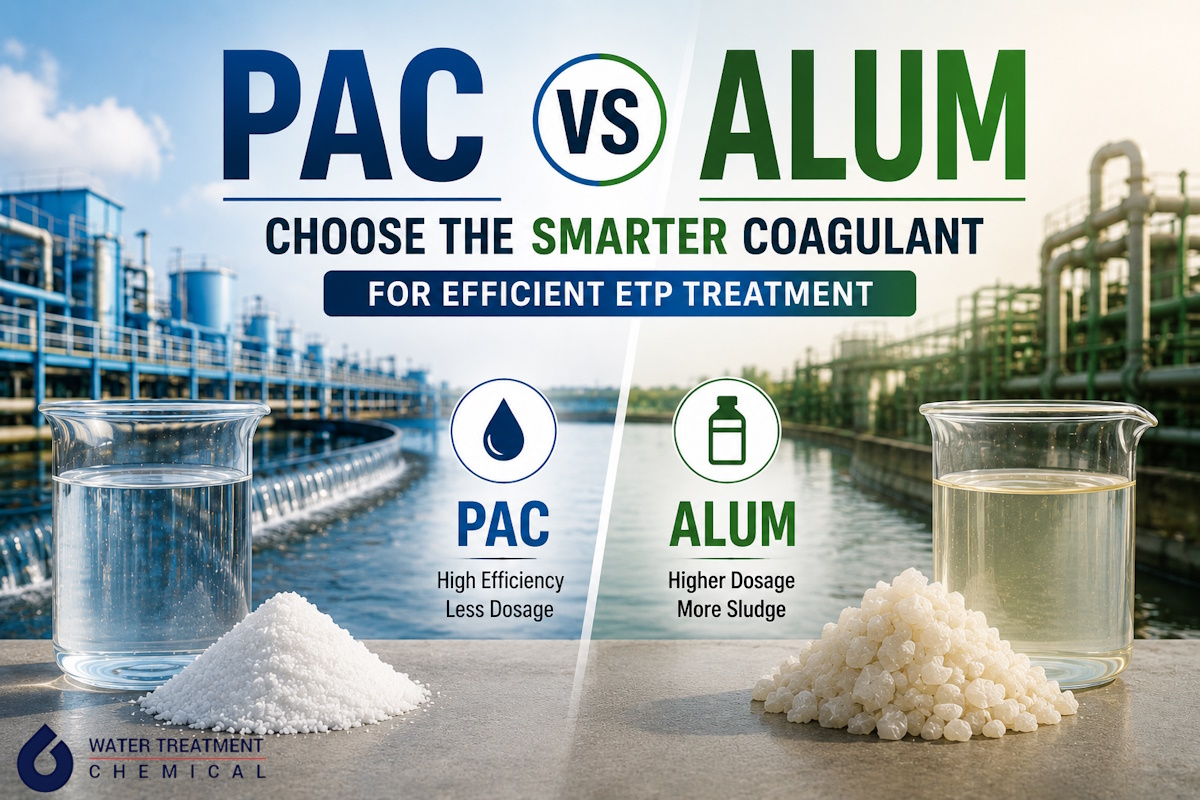
Industrial effluent treatment plants face continuous pressure to achieve strict discharge standards while minimizing operating costs. At the heart of most primary treatment stages lies the coagulation process, where suspended solids, colloidal matter, and organic pollutants are destabilized and aggregated for removal. For decades, alum has been the traditional chemical of choice for this step due to its low initial purchase cost. However, changing environmental norms and the push for operational efficiency have led many plant managers to evaluate modern alternatives like polyaluminium chloride.
Selecting the wrong coagulant does not just result in poor water quality, it cascades into higher sludge management expenses, increased chemical consumption for pH adjustment, and potential damage to downstream filtration systems. To make an informed decision, operators must look beyond the raw chemical price per kilogram and analyze the complete chemical lifecycle. This comparative analysis between PAC vs Alum evaluates their chemical behaviors, performance dynamics, and overall cost impact on industrial wastewater systems.
Need help choosing between PAC and Alum for your ETP plant?
Understanding Coagulation Dynamics in Effluent Treatment Plants
Before comparing specific chemicals, it is important to understand how Coagulation and Flocculation in Water Treatment work within complex industrial effluents. Raw wastewater contains particles carrying negative electrostatic charges that keep them suspended in water. Coagulation is the process of neutralizing these charges, allowing the particles to destabilize and begin forming microflocs. During the subsequent flocculation stage, these particles collide and combine into larger, heavier flocs that can be easily settled or filtered from the wastewater stream.
The Chemistry of Particle Destabilization
When coagulants are added to wastewater, they undergo rapid hydrolysis, forming positively charged metal hydroxide complexes. These complexes attract the negatively charged suspended impurities, neutralizing their surface charge. In industrial effluent treatment, this destabilization must occur rapidly and completely during the rapid mix phase to ensure that downstream sedimentation or flotation processes operate at peak efficiency.
Charge Neutralization and Sweep Flocculation
Coagulation occurs through two primary mechanisms: charge neutralization and sweep flocculation. Charge neutralization involves the direct adsorption of positive metal ions onto negative particle surfaces. Sweep flocculation, on the other hand, occurs when the metal hydroxide precipitates out of solution as a heavy, gelatinous mass, trapping suspended solids as it settles. While alum relies heavily on sweep flocculation at higher dosages, coagulants and flocculants designed with pre-polymerized aluminum structures offer superior charge neutralization at much lower concentrations.
PAC vs Alum: Key Differences in Chemical Profile
While both compounds are aluminum-based coagulants, their structural differences lead to vastly different performance characteristics in effluent treatment plants. Understanding these chemical profiles helps clarify why one option may significantly outperform the other under varying water conditions.
Chemical Composition and Basicity
Alum, or aluminum sulfate, is a simple, monomeric salt that hydrolyzes completely when added to water. In contrast, Poly Aluminium Chloride PAC is an inorganic polymer characterized by pre-polymerized aluminum ions. The key differentiator for PAC is its basicity, which represents the degree of hydroxyl substitution in the polymer chain. This pre-polymerized structure allows wastewater treatment chemicals of this type to react faster and form stronger, denser flocs than monomeric alum.
Temperature and pH Tolerance
Alum is highly sensitive to both water temperature and pH level. It performs optimally within a narrow pH range of 6.0 to 7.5. If the pH of the incoming effluent drops below or rises above this range, alum solubility increases, leading to residual aluminum carryover and poor turbidity removal. On the other hand, polyaluminium chloride in water treatment shows exceptional stability across a broader pH range, typically from 5.0 to 9.0, and retains its coagulating efficiency even in cold water temperatures.
Why pH Fluctuations Disrupt Alum Performance
When alum reacts with water, it consumes a significant amount of natural alkalinity, causing the pH of the system to drop. In plants treating low-alkalinity wastewater, this necessitates the constant addition of alkaline chemicals, such as lime or caustic soda, to maintain the pH within the narrow coagulating zone. This constant chemical balancing act complicates ETP chemical dosing and increases daily operating costs. PAC, because of its pre-polymerized and partially neutralized structure, consumes far less alkalinity, minimizing or completely eliminating the need for post-treatment pH adjusters.
Operational Performance Comparison in ETPs
In real-world operations, the performance of a coagulant is measured by its chemical consumption rate, the physical properties of the flocs it produces, and the volume of sludge left behind for disposal.
Dosage Efficiency and PAC Dosage Optimization
Because of its highly concentrated charge and pre-formed polymeric chains, PAC is highly efficient. In most industrial ETPs, the required dose of PAC is significantly lower than that of alum, often by a factor of two or three. Achieving precise PAC Dosage Optimization involves regular laboratory testing to find the exact minimum dose required for maximum turbidity and chemical oxygen demand removal. Over-dosing not only wastes money but can also restabilize suspended colloids, leading to poor settling.
Sludge Generation and Dewatering Characteristics
Sludge handling and disposal represent a major portion of ETP operating budgets. Alum produces a voluminous, gelatinous hydroxide sludge that holds a high percentage of bound water. This water retention makes alum sludge notoriously difficult and expensive to dewater, even with the addition of high-performance flocculants for wastewater treatment. PAC, however, forms denser, more crystalline flocs that release water easily, leading to a smaller volume of compact sludge that is much simpler to press, dry, and dispose of.
Calculating the Cost of Sludge Management
When calculating the true operational cost of PAC vs Alum, plant managers must include the costs of polymer conditioning, filter press operation, sludge drying beds, and landfill disposal fees. Although alum may have a lower purchase price, the sheer volume of wet sludge it generates frequently makes it the more expensive choice overall. Reducing sludge volume by 30% to 50% through PAC transition can save thousands of dollars annually in disposal costs alone.
Facing high chemical consumption, poor settling, or excessive sludge generation?
Selecting the Right Coagulant for Specific Industrial Effluents
The choice between PAC vs Alum often depends on the specific industry and the characteristics of the raw effluent being treated. High-strength wastewater with fluctuating organic loads presents different challenges than simple municipal sewage.
Textile Effluents with High Color and COD
Textile wastewater is characterized by high pH, temperature, intense color from synthetic dyes, and fluctuating organic loads. Alum struggles to treat such effluents effectively without massive acid additions to lower the pH first. PAC, especially high-basicity formulations, has proven highly effective at decoloring textile wastewater and reducing Chemical Oxygen Demand. Its polymeric structures adsorb dye molecules directly, creating heavy flocs that settle out rapidly in primary clarifiers.
Pharmaceutical and Chemical Process Wastewater
Pharmaceutical and chemical manufacturing plants produce highly variable, toxic wastewater that can easily disrupt standard chemical treatment processes. In these environments, consistent coagulation is critical to protect sensitive downstream biological treatment systems. Using chemical dosage optimization strategies with PAC ensures a more stable, resilient chemical primary stage, preventing untreatated organics from overloading biological aeration basins.
Economic and Environmental Impact Analysis
To build a compelling business case for chemical selection, industrial operators must evaluate the complete picture of chemical use, including direct costs, equipment wear, and regulatory compliance.
Direct Chemical Costs vs Total Cost of Operation
On a per-kilogram basis, alum is undeniably cheaper than polyaluminium chloride. However, focusing solely on the chemical price is a common mistake in procurement. To find the true cost of operation, plants must evaluate the overall balance of chemical consumption, pH correction costs, sludge volume, polymer use, and operator labor. When these factors are quantified, the total cost of operation with PAC is often equal to or lower than with alum, while delivering superior water quality.
Environmental Compliance and Salt Build-up (TDS)
With environmental regulations growing more stringent, plants must monitor the chemical fingerprint of their treated discharge. Alum addition introduces high levels of sulfates into the treated water, which increases Total Dissolved Solids and can cause scaling or corrosion in downstream reverse osmosis systems or receiving water bodies. PAC introduces fewer dissolved salts per unit of turbidity removed, making it the preferred option for zero-liquid discharge systems and facilities trying to minimize their environmental footprint.
Practical Strategies for Transitioning from Alum to PAC
Switching from a traditional alum system to a polyaluminium chloride system requires careful planning, laboratory testing, and physical system adjustments to ensure a smooth transition without process upsets.
Conducting Laboratory Jar Testing
Any chemical change must begin in the laboratory with a series of jar tests. Jar testing allows operators to simulate the coagulation and settling process under controlled conditions. During these tests, operators can compare the exact dosages of PAC vs Alum required to achieve target turbidity, color, and COD levels. It is also the ideal time to evaluate the settling velocity and density of the resulting flocs, which provides a preview of full-scale performance.
Adjusting Dosing Systems and Feed Rates
Because PAC is a much more concentrated coagulant than alum, dosing pumps must be recalibrated for lower volumetric flow rates. Dosing systems should be checked for material compatibility, although most standard plastic and chemical-resistant pumps used for alum are suitable for PAC. Additionally, because PAC hydrolyzes rapidly, the location of the injection point should be optimized to ensure instant, high-shear mixing immediately upon chemical addition.
Optimizing Your Wastewater Clarification Process
Selecting the ideal coagulant is a critical operational decision that directly impacts an industrial plant’s bottom line and environmental compliance status. While alum remains a useful and inexpensive option for simple, highly alkaline wastewater systems with low sludge disposal costs, Poly Aluminium Chloride PAC offers undeniable advantages for modern, high-throughput ETPs. Its superior performance under fluctuating pH levels, lower dosage requirements, and significantly reduced sludge footprint make it a highly cost-effective and reliable choice for complex industrial effluents.
To unlock the full potential of your chemical program, avoid relying on guesswork. Continuous monitoring, precise dosing control, and regular jar testing are the keys to maintaining optimal clarifier performance. Partnering with an experienced chemical supplier who can provide on-site technical support, water analysis, and custom formulations ensures that your ETP runs efficiently, safely, and well within regulatory compliance limits day in and day out.
Ready to improve your wastewater treatment efficiency with the right PAC solution?