
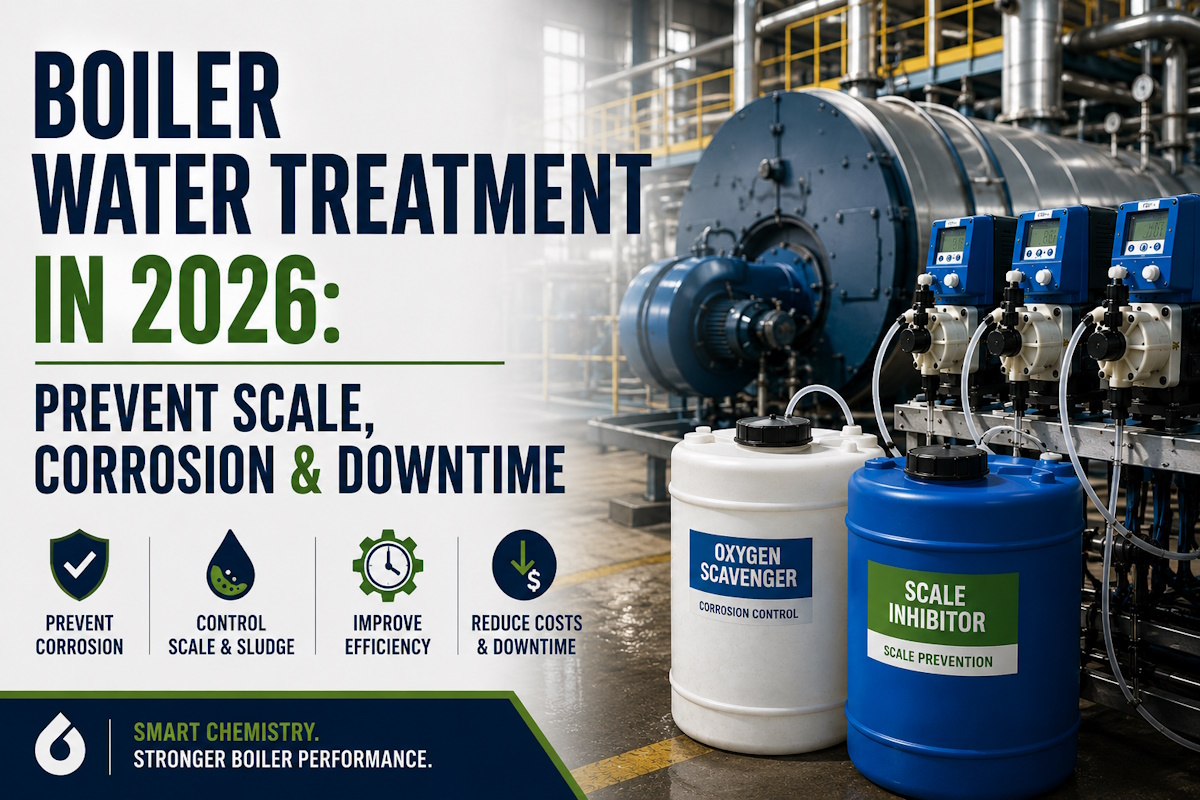
Boiler failures are expensive, disruptive, and often preventable. In many industrial systems, the problem starts with poor feedwater quality, incorrect chemical dosing, or a treatment program that has not been updated for current operating conditions.
That is why boiler water treatment is not something facilities can afford to ignore.
In 2026, boiler water treatment is about more than adding chemicals and running occasional tests. Facilities are paying closer attention to water quality monitoring, energy efficiency, chemical safety, blowdown control, condensate protection, and environmental compliance.
Whether you operate boilers in manufacturing, commercial HVAC, food processing, textiles, pharmaceuticals, power generation, or any other industrial facility, choosing the right boiler water treatment chemicals can help reduce corrosion, scale, sludge, downtime, and costly repairs.
This guide explains what boiler water treatment chemicals are, how they work, which types are commonly used, and how to choose the right water treatment chemical supplier for your system.
Need Help Choosing the Right Boiler Water Treatment Chemicals?
Why Boiler Water Treatment Matters in 2026
Boilers operate under heat, pressure, and continuous water circulation. That makes water quality one of the most important factors in boiler performance.
The water entering a boiler is not just water. It may contain dissolved oxygen, carbon dioxide, hardness minerals, silica, suspended solids, dissolved salts, oil contamination, and other impurities. If these are not controlled, they can damage the boiler from the inside.
Poor boiler water treatment can lead to several major issues.
Corrosion
Corrosion eats away at metal surfaces inside the boiler, feedwater system, condensate lines, and steam system. Over time, corrosion can cause leaks, tube failures, equipment damage, and unsafe operating conditions.
Dissolved oxygen and carbon dioxide are two common contributors to corrosion. Oxygen can attack boiler metal directly, while carbon dioxide can dissolve in condensate and form carbonic acid.
Scale Buildup
Scale forms when minerals such as calcium and magnesium come out of the water and deposit on heat transfer surfaces. Even a thin layer of scale can reduce heat transfer, increase fuel consumption, and cause overheating.
If scale continues to build, it can restrict water flow, damage tubes, and reduce boiler efficiency.
Sludge Formation
Sludge is caused by suspended solids, precipitated minerals, corrosion products, and other contaminants that settle in low-flow areas. Sludge reduces water circulation, creates uneven heating, and increases the risk of under-deposit corrosion.
Foaming and Carryover
Foaming happens when bubbles form on the surface of boiler water. Carryover occurs when boiler water gets carried into the steam line along with steam.
This can contaminate steam, damage turbines or process equipment, cause water hammer, and reduce steam quality. High dissolved solids, excess alkalinity, oil contamination, and improper chemical dosing can all contribute to foaming and carryover.
Higher Operating Costs
Untreated or poorly treated boiler water can increase fuel use, chemical waste, maintenance costs, blowdown losses, and downtime. A proper chemical treatment program helps protect the boiler while improving reliability and efficiency.
What Are Boiler Water Treatment Chemicals?
Boiler water treatment chemicals are specialized formulations used to control water chemistry inside boilers and steam systems. Their purpose is to protect the boiler from corrosion, scale, sludge, foaming, carryover, and condensate-line damage.
These chemicals are not general cleaning products. They are designed to work under specific boiler operating conditions such as high temperature, pressure, water concentration, and steam generation.
Some Boiler Chemicals perform one specific function. Others are blended products that combine multiple functions, such as oxygen removal, pH control, scale inhibition, sludge conditioning, and condensate protection.
The right treatment program depends on several factors, including boiler type, operating pressure, feedwater source, pretreatment system, makeup water quality, condensate return percentage, and industry requirements.
Main Types of Boiler Water Treatment Chemicals
Different boiler problems require different chemical solutions. Below are the most common types of boiler water treatment chemicals used in industrial and commercial systems.
1. Oxygen Scavengers
Dissolved oxygen is one of the biggest causes of corrosion in boiler systems. When oxygen reacts with metal surfaces, it creates rust and pitting. These pits can become deep and localized, eventually causing leaks or tube failures.
Oxygen scavengers are chemicals that react with dissolved oxygen and remove it before it can attack the boiler metal.
To strengthen corrosion protection, many facilities also use Boiler Corrosion Inhibitors as part of a complete treatment program.
Common oxygen scavengers include:
- Sodium sulfite
- Catalyzed sodium sulfite
- DEHA
- Ascorbic acid
- Hydroquinone
- Carbohydrazide, where permitted and suitable
Sodium sulfite is commonly used in many low- and medium-pressure boilers. Organic oxygen scavengers may be used in systems where volatile protection, lower solids contribution, or specific operating needs are important.
Oxygen scavengers are often dosed into the feedwater tank, deaerator storage section, or feedwater line. The best feed point depends on the system design and the reaction time required.
Mechanical deaeration is important, but it may not remove every trace of oxygen. That is why many boiler systems use both deaeration and chemical oxygen scavenging.
2. Scale Inhibitors
Scale inhibitors help prevent hardness minerals from forming hard deposits on boiler surfaces. Calcium, magnesium, silica, and other dissolved minerals can create scale if they are not properly controlled.
Scale acts like insulation. It blocks heat transfer between the flame side and the water side of the boiler. When this happens, the boiler needs more fuel to produce the same steam output. In severe cases, metal surfaces overheat and fail.
Common scale control chemicals include:
- Phosphates
- Polyacrylates
- Polymers
- Chelants
- Dispersants
Phosphate programs are commonly used to control hardness by converting calcium into a soft sludge that can be removed through blowdown. Polymer-based treatments help keep particles suspended so they do not stick to heat transfer surfaces.
The right scale inhibitor depends on boiler pressure, feedwater hardness, pretreatment quality, and blowdown control.
3. Alkalinity Builders and pH Adjusters
Boiler water must usually be maintained in an alkaline condition to reduce corrosion and support chemical treatment performance. However, the correct pH range is not the same for every boiler.
The ideal pH depends on boiler pressure, metallurgy, feedwater quality, system design, and manufacturer or consultant recommendations.
If the water becomes too acidic, corrosion risk increases. If alkalinity becomes too high, it may contribute to foaming, carryover, caustic attack, or other operational issues.
Common alkalinity builders and pH adjusters include:
- Sodium hydroxide
- Sodium carbonate
- Sodium phosphate
- Neutralizing amines
- Ammonia, where suitable
These chemicals must be dosed carefully. More chemical is not always better. Overdosing can create new problems, including high pH, unstable alkalinity, carryover, and corrosion in other parts of the system.
4. Sludge Conditioners
Even with good pretreatment, some solids can enter the boiler. These solids may come from hardness leakage, corrosion products, suspended matter, or process contamination.
Sludge conditioners help prevent these solids from sticking to boiler surfaces. Instead, they keep the particles dispersed in the boiler water so they can be removed during blowdown.
Sludge conditioners are especially useful in boilers that experience variable makeup water quality or where complete removal of impurities is difficult.
Benefits of sludge conditioners include:
- Reduced deposit formation
- Cleaner heat transfer surfaces
- Improved blowdown effectiveness
- Lower risk of under-deposit corrosion
- Better boiler reliability
Sludge conditioning must work together with proper blowdown. If blowdown is neglected, conditioned solids can still concentrate inside the boiler.
5. Antifoaming Agents
Foaming can cause boiler water to rise and carry over into the steam system. This creates wet steam, contaminated steam, and potential damage to downstream equipment.
Antifoaming agents help control foam formation inside the boiler drum. They are usually dosed in very small amounts.
Common antifoaming agents include silicone-based formulations and other specialty defoamers designed for boiler applications.
However, antifoams should not be used as a substitute for proper water chemistry control. If foaming is frequent, the root cause must be investigated. Possible causes include high TDS, excess alkalinity, oil contamination, suspended solids, or improper chemical dosing.
6. Condensate Line Treatments
Condensate is the steam that has cooled and returned to liquid form. In many facilities, condensate is returned to the boiler to save water, heat, and treatment cost.
However, condensate systems are vulnerable to corrosion. Carbon dioxide can dissolve in condensate and form carbonic acid, which attacks return lines, tanks, and fittings.
Condensate treatment chemicals help protect the return system.
Common condensate treatments include:
- Neutralizing amines
- Filming amines
- Oxygen scavenger/passivator treatments
Neutralizing amines raise condensate pH by neutralizing carbonic acid. Filming amines form a thin protective layer on metal surfaces. In some systems, a combination of neutralizing and filming amines may be used.
Condensate treatment is especially important in systems with long return lines, high condensate return rates, carbon dioxide issues, or mixed metallurgy.
Boiler Water Treatment Chemical Selection Table
| Boiler Problem | Chemical Type | Common Examples | Main Purpose |
| Oxygen corrosion | Oxygen scavengers | Sodium sulfite, DEHA, ascorbic acid | Remove dissolved oxygen |
| Scale buildup | Scale inhibitors | Phosphates, polymers, polyacrylates | Prevent mineral deposits |
| Low pH or acidity | Alkalinity builders | Sodium hydroxide, sodium carbonate | Maintain alkaline conditions |
| Suspended solids | Sludge conditioners | Polymers, dispersants | Keep solids suspended for blowdown |
| Foaming and carryover | Antifoaming agents | Silicone-based antifoams | Reduce foam formation |
| Condensate corrosion | Condensate treatments | Neutralizing amines, filming amines | Protect return lines |
Need support with boiler water testing, dosing, or chemical selection?
Key Boiler Water Tests to Monitor in 2026
A boiler chemical program is only effective when it is supported by regular water testing. Without testing, chemical dosing becomes guesswork.
Important boiler water tests include:
pH
pH shows whether the water is acidic, neutral, or alkaline. Boiler water, feedwater, and condensate pH should be monitored because pH directly affects corrosion, scale, and chemical performance.
Conductivity
Conductivity measures the amount of dissolved ionic material in the water. It is commonly used to monitor dissolved solids and control blowdown.
Total Dissolved Solids
TDS represents the concentration of dissolved solids in the boiler water. If TDS gets too high, it can contribute to foaming, carryover, and steam contamination.
Dissolved Oxygen
Dissolved oxygen testing helps confirm whether deaeration and oxygen scavenger treatment are working properly. Even low oxygen levels can contribute to pitting corrosion in hot water systems.
Hardness
Hardness testing checks for calcium and magnesium. Any hardness leakage into the boiler can increase the risk of scale.
Alkalinity
Alkalinity helps maintain pH control and supports internal boiler treatment. Both low and excessive alkalinity can cause problems.
Phosphate Reserve
For systems using phosphate treatment, phosphate levels should be monitored to confirm proper scale control.
Sulfite Reserve
In systems using sodium sulfite, sulfite residual testing helps confirm that enough oxygen scavenger is present.
Silica
Silica is especially important in higher-pressure boilers and systems where steam purity matters. If silica carries over with steam, it can create deposits in turbines or downstream equipment.
Chlorides
Chlorides can indicate concentration cycles, contamination, or water leakage. High chloride levels can increase corrosion risk.
Iron and Copper
Iron and copper testing can indicate active corrosion somewhere in the boiler, feedwater, or condensate system.
Condensate pH
Condensate pH helps determine whether return lines are protected against carbonic acid corrosion.
How to Choose the Right Boiler Water Treatment Program
There is no one-size-fits-all boiler chemical program. The right treatment depends on your system and operating conditions.
For facilities that manage multiple water systems, choosing the right Industrial Water Treatment Chemicals can also improve overall plant reliability and reduce maintenance costs.
Before choosing chemicals, consider the following factors.
Feedwater Source
Municipal water, borewell water, surface water, RO water, softened water, and demineralized water all have different chemistry. The treatment program must match the actual water source.
Boiler Type
Firetube boilers, watertube boilers, electric boilers, and high-pressure boilers may require different treatment approaches.
Operating Pressure
Boiler pressure affects chemical selection, allowable impurity levels, steam purity requirements, and the risk of carryover.
Pretreatment System
A boiler with softening, RO, deaeration, filtration, or demineralization may require a different chemical program than a boiler with minimal pretreatment.
Makeup Water Percentage
Systems with high makeup water use usually need stronger control because more impurities enter the system.
Condensate Return Rate
High condensate return can improve efficiency, but it also requires proper condensate protection to prevent corrosion products from returning to the boiler.
Steam Use
If steam contacts food, pharmaceuticals, or sensitive processes, chemical selection must consider regulatory and quality requirements.
Blowdown Practice
Chemical treatment must work with the blowdown schedule. Poor blowdown control can cause high TDS, sludge accumulation, and wasted energy.
What Has Changed in Boiler Water Treatment in 2026?
The fundamentals of boiler water treatment remain the same: prevent corrosion, prevent scale, control solids, protect condensate, and maintain steam quality.
However, the way facilities manage boiler water is changing.
1. Smarter Chemical Dosing
Automated chemical dosing systems are becoming more common. These systems help maintain more consistent treatment levels and reduce human error.
Modern systems may include chemical feed pumps, controllers, alarms, sensors, and data logging. This allows operators to respond faster when water chemistry moves outside the target range.
2. Real-Time Water Quality Monitoring
Many facilities are moving from manual-only testing to a combination of manual testing and online monitoring.
Online monitoring can track parameters such as conductivity, pH, dissolved oxygen, and chemical residuals. This helps identify trends before they become major problems.
Manual testing is still important because sensors require calibration and verification. The strongest programs use both online monitoring and routine grab-sample testing.
3. More Focus on Energy Efficiency
Boiler treatment is directly connected to energy performance. Scale, sludge, excess blowdown, and poor condensate return can all increase operating costs.
In 2026, many facilities are reviewing boiler water treatment as part of energy-saving and sustainability programs.
4. Lower-Impact Chemical Programs
There is growing interest in treatment programs that reduce environmental impact. This may include phosphate-free or low-phosphate options, biodegradable components, lower-toxicity formulations, and better blowdown management.
The right approach depends on local discharge rules, site requirements, and process conditions.
5. Stronger Supplier Support
Facilities increasingly expect suppliers to provide more than chemicals. They want water testing, reporting, troubleshooting, dosing guidance, staff training, and ongoing program optimization.
A good supplier should help prevent problems, not just deliver drums.
Common Boiler Water Treatment Mistakes
Even a good chemical program can fail if it is not managed properly. Here are the most common mistakes to avoid.
1. Not Testing Water Regularly
If you are not testing, you are guessing. Boiler water chemistry can change due to makeup water quality, load changes, condensate contamination, chemical pump issues, or blowdown changes.
Regular testing helps detect problems early.
2. Overdosing Chemicals
Adding more chemical does not always mean better protection. Overdosing can cause high TDS, pH swings, foaming, carryover, or corrosion.
Chemical dosing should be based on test results and supplier recommendations.
3. Skipping Blowdown
Blowdown removes dissolved and suspended solids from the boiler. If blowdown is skipped or poorly controlled, solids concentrate inside the boiler and increase the risk of scale, sludge, and carryover.
4. Ignoring the Condensate System
Many facilities focus only on the boiler and forget the condensate return system. This is a mistake. Corroded return lines can send iron and other corrosion products back into the boiler.
Condensate protection should be part of the overall treatment program.
5. Mixing Incompatible Chemicals
Using chemicals from different suppliers without checking compatibility can cause unwanted reactions, poor performance, precipitation, or safety issues.
Always confirm compatibility before changing or mixing products.
6. Not Maintaining Dosing Equipment
Chemical feed pumps, tanks, injection lines, and controllers need regular inspection. A good chemical program can fail if the dosing pump stops working or if the injection point becomes blocked.
7. Using the Same Program for Years Without Review
Boiler systems change over time. Load patterns, water sources, production schedules, pretreatment equipment, and regulations may change.
Your treatment program should be reviewed regularly to make sure it still fits the system.
How to Choose the Right Water Treatment Chemical Supplier
The supplier you choose matters as much as the chemicals you buy. A reliable water treatment chemical supplier should help you understand your system, test your water, recommend the right chemicals, and support long-term performance.
Look for a supplier that offers the following.
Water Testing Support
The supplier should be able to test feedwater, boiler water, condensate, and makeup water. Testing may be done on-site or through a laboratory.
Customized Treatment Plans
Avoid suppliers that offer the same chemical package for every boiler. Your system needs a program based on actual water quality, pressure, operating conditions, and goals.
Clear Dosing Instructions
Your team should know exactly how much chemical to dose, where to dose it, and how to verify that the dosage is working.
Technical Support
When a boiler problem appears, you need a supplier that can help quickly. Good technical support includes troubleshooting, water analysis, system review, and corrective action guidance.
Regulatory Knowledge
Industries such as food processing, pharmaceuticals, healthcare, and power generation may have stricter requirements. Your supplier should understand relevant safety, discharge, and quality standards.
Equipment Knowledge
A strong supplier should also understand chemical dosing pumps, controllers, sensors, deaerators, softeners, RO systems, and blowdown controls.
Documentation and Reporting
Testing reports, service logs, chemical usage records, and trend data can help your facility make better decisions and prove compliance when required.
Is Boiler Water Treatment Worth the Cost?
Yes. Boiler water treatment is usually far less expensive than boiler failure.
A proper chemical program can help reduce:
- Emergency repair costs
- Boiler downtime
- Tube failures
- Fuel waste
- Scale-related efficiency losses
- Corrosion damage
- Steam contamination
- Replacement part costs
- Safety risks
Whether you operate a small commercial boiler or a large industrial steam system, water treatment should be treated as a core maintenance activity.
When boiler water chemistry is controlled, the system runs cleaner, safer, and more efficiently.
Final Thoughts
Boilers are strong machines, but they are sensitive to poor water chemistry. A small issue with dissolved oxygen, hardness, pH, TDS, sludge, or condensate corrosion can turn into a costly failure if it is ignored.
In 2026, the best boiler water treatment programs combine the right chemicals, proper testing, smart dosing, regular blowdown, condensate protection, and expert supplier support.
Do not rely on guesswork. Use the right boiler water treatment chemicals, monitor your system consistently, and work with a supplier who understands your boiler, your water, and your operating goals.
A strong treatment program today can help prevent expensive boiler problems tomorrow.
Ready to Stop Guessing and Start Protecting Your Boiler System?