
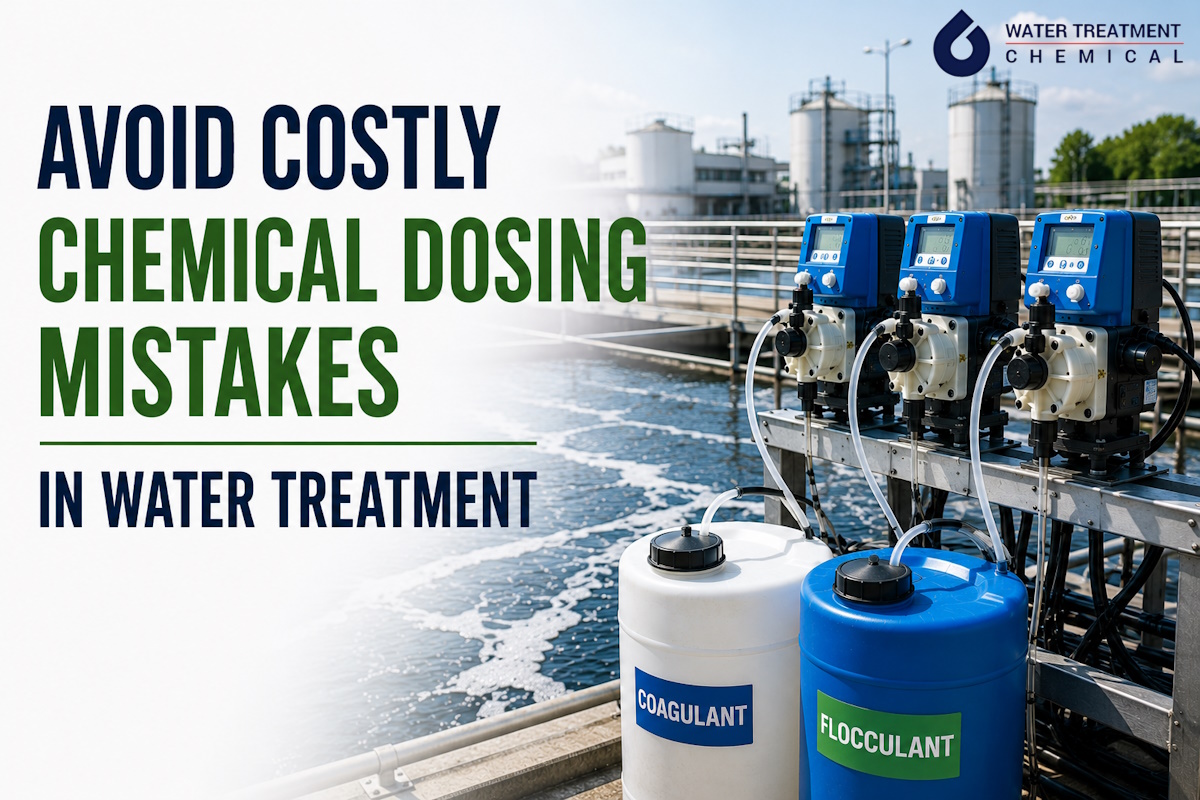
In industrial wastewater treatment, the chemistry of the Effluent Treatment Plant (ETP) or Sewage Treatment Plant (STP) is a delicate balance. Many plant managers and utility engineers view water treatment as a utility that simply requires a set volume of chemicals to meet discharge standards. However, this perspective overlooks the complex chemical interactions occurring within flash mixers, flocculators, clarifiers, and filtration systems. Improper chemical application is one of the most common, yet overlooked, sources of operational waste in industrial facilities today.
When chemical dosing in water treatment is not precisely calibrated to the incoming wastewater characteristics, operational costs quickly escalate. This inflation does not just manifest as higher chemical purchasing bills. It also appears as excessive sludge generation, accelerated equipment wear, frequent membrane fouling, and unexpected compliance penalties. To optimize treatment systems and secure long-term efficiency, operators must understand where dosing errors occur, why they happen, and how to correct them systematically.
Need help reducing water treatment costs?
The Hidden Financial Impact of Imprecise Chemical Dosing
Every milligram of excess chemical added to a treatment system carries a compounding financial penalty. While purchasing raw chemicals is an obvious direct cost, the downstream operational consequences of incorrect chemical dosing in water treatment are often far more expensive.
Direct Chemical Waste vs. System Degradation
When chemicals are applied in excess, the unreacted portions do not simply disappear. Instead, they remain in the water column or precipitate out as additional sludge. For example, over-dosing inorganic coagulants like alum or iron salts directly increases the total dissolved solids (TDS) and conductivity of the treated water. This makes downstream purification, such as reverse osmosis (RO), much more difficult and energy-intensive.
Membrane Fouling and Equipment Wear
Unreacted chemical polymers or residual metal coagulants carry forward into ultrafiltration (UF) and RO systems. Residual cationic polymers are particularly destructive to RO membranes, as they bind irreversibly to negatively charged polyamide surfaces. This leads to severe organic fouling, decreased permeate flux, and shortened membrane life. The financial impact of replacing a fouled RO membrane stack prematurely can dwarf the annual savings of a poorly managed chemical program.
Cost Implications of Frequent Clean-in-Place (CIP) Cycles
When membranes or filters foul due to chemical carryover, operators must perform Clean-in-Place (CIP) cycles more frequently. Each CIP cycle requires specialized acid, caustic, and surfactant cleaners, alongside thousands of gallons of high-purity water. The thermal energy required to heat CIP chemicals, combined with the labor and production downtime during cleaning, dramatically increases the facility’s overall operating expenditure.
Increased Sludge Disposal Costs
Excessive chemical use yields high volumes of chemical sludge. In many industrial wastewater treatment systems, sludge handling, dewatering, and hazardous waste disposal represent the largest single line item in the utility budget. Over-dosing coagulants generates a bulky, water-binding metal hydroxide sludge that is exceptionally difficult to dewater, forcing plants to pay for hauling high-water-weight waste to landfills.
Mistake 1: Over-Dosing and Under-Dosing Coagulants
Coagulation is the cornerstone of solid-liquid separation. It destabilizes negatively charged colloidal particles, allowing them to agglomerate. Achieving the correct coagulant dose requires understanding charge neutralization dynamics, yet many operators run their systems on static dosing rates regardless of daily flow and load changes.
The Chemistry of Charge Neutralization
Colloidal particles in industrial wastewater carry a natural negative electrostatic charge, which keeps them suspended in water. Coagulants introduce positively charged metal ions to neutralize these negative charges, allowing the particles to come together. Under-dosing leaves a portion of the colloids stabilized, resulting in cloudy effluent and poor settling. Over-dosing, however, can reverse the charge of the particles, giving them a net positive charge. This restabilizes the colloids, recreating the exact dispersion problem the operator was trying to solve, but at a much higher chemical cost.
PAC Dosing in Water Treatment Dynamics
Polyaluminum chloride (PAC) has largely replaced alum in many industrial wastewater treatment plants due to its pre-polymerized structure and high charge density.
However, pac dosing in water treatment requires careful management. Because PAC is highly efficient, the window of optimum dosage is narrower than that of traditional alum. Over-dosing PAC introduces excess aluminum ions into the system, which can precipitate as aluminum hydroxide downstream, blinding sand filters and fouling membranes. Conversely, under-dosing fails to initiate rapid micro-floc formation, leading to pin-floc carryover from the clarifier.
To optimize this process, plants must continuously monitor parameters like zeta potential or perform regular jar testing. Relying on visual observation alone to adjust PAC dosing rates is an imprecise practice that routinely leads to chemical waste.
Experiencing high chemical consumption or turbidity issues?
Mistake 2: Poor Flocculant Selection and Feed Rates
Flocculants, typically long-chain polyacrylamides, bind micro-flocs together into large, heavy masses that settle rapidly. Despite their critical role, flocculant selection and dosing are frequently mismanaged, leading to severe incorrect flocculant dosage problems.
Understanding Incorrect Flocculant Dosage Problems
When flocculants are under-dosed, the micro-flocs formed during coagulation lack the structural bridging needed to create heavy macro-flocs. As a result, the flocculant cannot withstand the shear forces within the clarifier feed well, leading to floc breakage and poor settling rates. The sludge blanket becomes loose and unstable, causing solids carryover into the effluent.
On the other hand, over-dosing flocculants is equally problematic. Excess polymer molecules do not find open particle surfaces to bind to. Instead, they remain dissolved in the water, creating a highly viscous, sticky fluid. This excess polymer coats the filter media, blinds dewatering belts, and forms a slimy layer over clarifier weirs. The result is a dramatic drop in filtration rates and a massive increase in backwash frequency.
Viscosity and Polymer Shear Degradation
Polymers are long, fragile molecular chains. If they are mixed too aggressively after activation, these chains shear and break, losing their bridging capability. To compensate for sheared polymer, operators often turn up the dosing pumps, unaware that they are compounding the issue. Flocculants must be prepared with precise aging times and low-shear mixing to ensure the polymer chains are fully uncoiled and active before they enter the treatment stream.
Sludge De-watering Failures and Cost Penalties
In sludge dewatering applications, such as screw presses, belt presses, or centrifuges, incorrect flocculant dosage problems directly translate to wet cake. Over-polymerized sludge holds onto water stubbornly, leading to low dryness levels in the discharged cake. Every percentage point of water retained in the sludge cake increases the total weight of the waste, directly driving up transport and disposal costs. Furthermore, free polymer in the filtrate recirculates back to the head of the plant, disrupting upstream processes and creating an expensive, self-reinforcing cycle of chemical instability.
Mistake 3: Neglecting pH and Temperature Compensation
Chemical reactions in water treatment are highly dependent on environmental conditions. Two of the most critical variables that operators often ignore are pH and temperature.
How pH Dictates Chemical Speciation
Inorganic coagulants like alum, PAC, and iron salts rely on pH-sensitive hydrolysis reactions to form highly charged cationic species. For instance, alum performs best in a narrow pH range of 5.5 to 6.5. If the pH drops below this range, the aluminum remains soluble as cationic monomeric species, failing to form the sweeping precipitates needed for sweep flocculation. If the pH climbs too high, aluminum forms soluble aluminate anions, which are completely ineffective for coagulation and pass directly into the treated water. PAC has a wider operating pH range than alum, but its efficiency still drops significantly if the system’s pH is not carefully controlled.
Metal Hydroxide Solubility Curves
Every metal coagulant has an optimal solubility curve. If the wastewater pH drifts outside this optimal zone, the coagulant cannot precipitate properly. The unprecipitated metals pass through clarifiers and downstream filters, eventually fouling downstream reverse osmosis membranes or violating heavy metal discharge limits. Proper pH adjustment prior to coagulant addition is not an optional step; it is a fundamental prerequisite for chemical efficiency.
Mistake 4: Inadequate Mixing and Contact Time
For chemical dosing in water treatment to work efficiently, the injected chemical must come into rapid, intimate contact with the target particles or compounds. Poor hydraulics can undermine even the most sophisticated chemical formulations.
Rapid Mix vs. Slow Mix Hydraulics
Coagulants require rapid, high-intensity mixing to disperse the chemical across the stream in a fraction of a second. This is because the charge-neutralization reaction occurs almost instantaneously. If the mixing is too slow, the chemical will concentrate in localized pockets, leading to localized over-dosing while the rest of the stream remains untreated.
Conversely, flocculants require gentle, low-shear mixing. Once the micro-flocs begin to form and bind together, aggressive mixing will tear the delicate polymer bridges apart. Once broken, these polymer chains cannot easily re-form. Therefore, a transition from a high-shear rapid mix zone to a low-shear flocculation zone is critical for minimizing chemical waste.
Short-Circuiting in Reaction Chambers
If the design of the reaction tank or static mixer is flawed, a portion of the incoming wastewater may bypass the active mixing zone entirely. This phenomenon, known as short-circuiting, means that some water receives no chemical treatment, while other portions are heavily over-treated. Operators often try to correct this by increasing the overall dosing rate, which leads to high chemical bills without ever resolving the underlying hydraulic bypass.
Mistake 5: Failing to Adjust for Raw Water Fluctuations
Industrial manufacturing processes are rarely static. A food and beverage plant, a textile mill, or a chemical facility will discharge wastewater that varies significantly in flow, temperature, pH, organic load, and suspended solids throughout the day.
Seasonal and Process-Driven Influent Variabilities
Many plants operate on a fixed chemical feed rate, often set by a water treatment chemical supplier years prior during system commissioning. If the plant’s production volume drops, or if a clean-in-place cycle in production discharges a high-strength waste stream, the fixed chemical dose becomes completely inappropriate. During low-load periods, the system is heavily over-dosed, leading to chemical waste and membrane fouling. During peak-load periods, the system is under-dosed, leading to poor effluent quality and potential discharge violations.
The Danger of Static Dosing Regimes
Relying on a constant stroke setting on a diaphragm pump is an outdated approach to industrial wastewater treatment. Modern facilities must transition to flow-proportional or load-proportional dosing systems. By linking dosing pump speeds to flow meters and real-time analytical instruments, such as turbidimeters or streaming current detectors, plants can ensure they feed only the exact amount of chemical required at any given second.
Systematic Strategies to Optimize Dosing Accuracy
Correcting dosing errors requires a structured approach that combines laboratory testing, modern instrumentation, and partnership with an experienced water treatment chemical supplier.
Implementing Jar Testing and Zeta Potential Monitoring
The jar test remains one of the most reliable and cost-effective tools for optimizing chemical dosing in water treatment. Operators should conduct jar tests regularly, especially when production processes change or seasonal raw water quality shifts. By systematically varying coagulant, flocculant, and pH-adjustment levels in a controlled laboratory environment, operators can determine the precise dosage curves for their specific wastewater matrix.
For highly sensitive systems, particularly those feeding downstream membrane filtration plants, monitoring zeta potential provides a precise quantitative measure of colloidal charge. Maintaining the zeta potential of the coagulated water close to zero millivolts ensures optimal destabilization without the risk of charge reversal and restabilization.
Selecting a Reliable Water Treatment Chemical Supplier
Achieving chemical efficiency requires more than just buying commodity chemicals at the lowest price per kilogram. A true partnership with a specialized water treatment chemical supplier provides access to diagnostic expertise, custom formulations, and ongoing system audits. An experienced supplier will analyze your specific wastewater, evaluate your plant’s hydraulics, and recommend tailored chemistry, such as specialized coagulant blends or high-activity polymers, that reduce overall consumption and lower your total cost of ownership.
Ready to optimize your treatment process?